
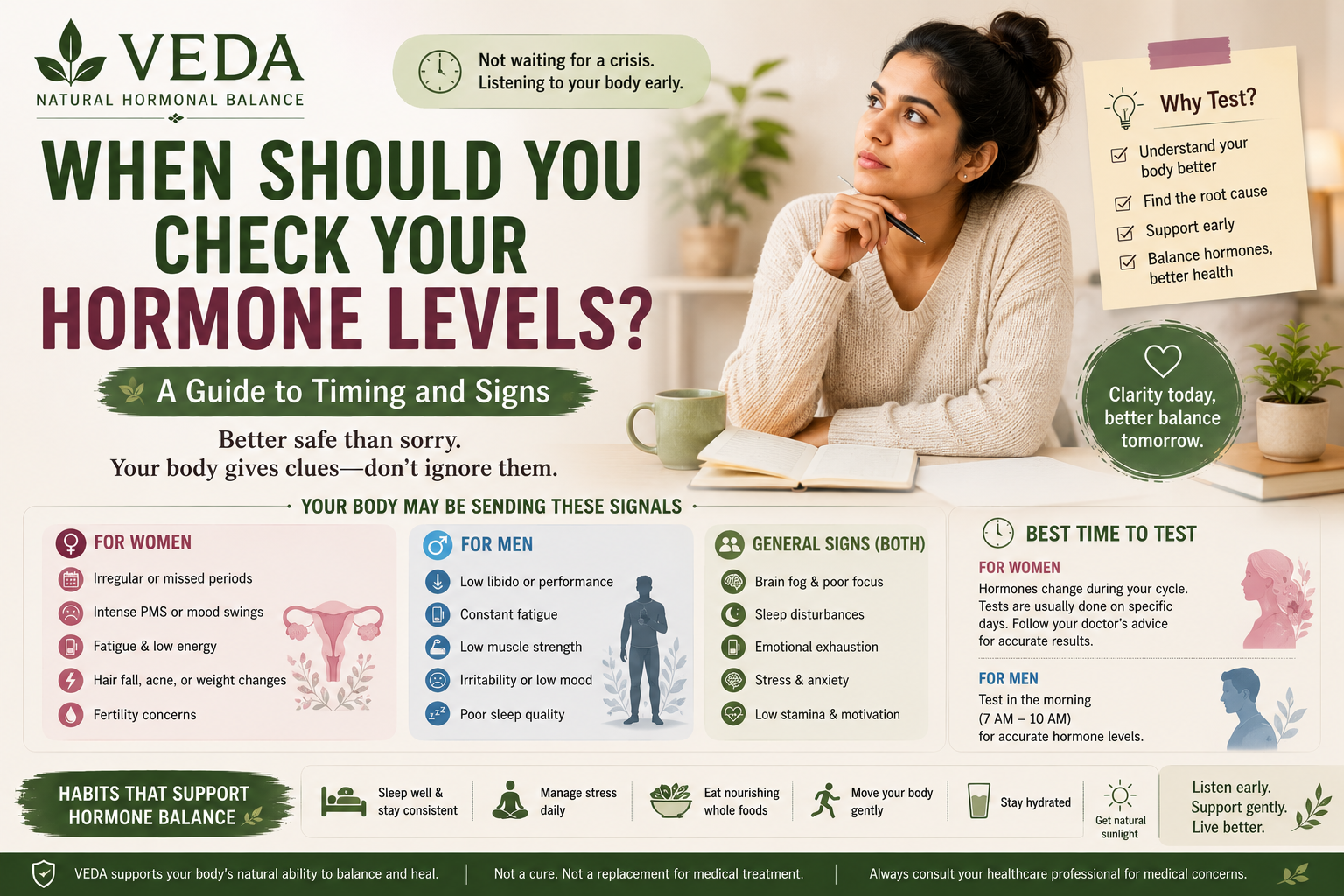
When Should I Check My Hormone Levels?
Most people don’t think about hormones until something feels “off.”
Not dramatic.
Just different.
You feel more tired than usual.
Your mood changes more easily.
Your cycle becomes irregular.
Your energy doesn’t feel stable anymore.
And eventually you start wondering:
“Should I get my hormones checked?”
Honestly?
Sometimes, it’s better to check early than ignore signals for too long.
Your Body Usually Gives Clues Before Bigger Problems
Hormonal imbalance rarely appears overnight.
Your body often whispers before it shouts.
You may notice:
- Fatigue that doesn’t improve with rest
- Mood swings or irritability
- Sleep disturbances
- Irregular periods
- Low motivation or brain fog
- Low stamina or reduced vitality
These are common signs that people often dismiss as “normal stress.”
But sometimes, they are signs your body needs attention.
What Hormones Actually Do (Simple Explanation)
Hormones help regulate:
- Energy
- Mood
- Sleep
- Reproductive health
- Metabolism
- Stress response
When hormonal rhythm becomes disrupted, multiple systems can feel “off” together.
Here’s the simple chain:
Stress + Lifestyle Imbalance → Hormonal Changes → Body Signals
- Stress affects cortisol
- Cortisol influences reproductive and energy hormones
- Sleep, mood, and recovery become affected
- Your body starts sending signals through symptoms
Stress-linked hormonal imbalance is commonly connected to fatigue, cycle changes, mood instability, and low vitality.
Signs That May Mean It’s Time for a Hormone Check
You don’t need to wait for a crisis.
A
doctor hormone check
may be worth considering if you notice:
🌙 For Women
- Irregular or missed periods
- PMS becoming more intense
- Mood swings or emotional sensitivity
- Low energy or cycle-related fatigue
💪 For Men
- Low motivation or stamina
- Reduced libido
- Constant fatigue
- Stress-related performance issues
🧠 General Signs (Both)
- Feeling tired all the time
- Poor sleep quality
- Emotional exhaustion
- Brain fog
- Difficulty handling stress
These signs don’t automatically mean something serious.
They simply mean your body may need support or evaluation.
When to Test Hormones (Timing Matters)
Many people ask:
“What’s the best hormone test timing?”
The answer depends on the hormones being checked.
🌸 For Women
Hormone testing is often done during specific phases of the menstrual cycle because hormone levels naturally fluctuate.
For example:
- Some hormones are commonly checked early in the cycle
- Others may be tested around ovulation or later phases
This is why doctors often ask about cycle timing before testing.
🔵 For Men
Hormone levels like testosterone are often highest in the morning.
So testing is commonly done earlier in the day.
⚠️ Important Reminder
Always follow medical guidance for
when to test hormones.
Because timing can affect accuracy.
A Perspective That Reduces Fear
Checking hormones does not mean something is “wrong” with you.
It means you’re listening to your body early.
That’s responsible—not dramatic.
Preventive wellness is about awareness before imbalance becomes deeper.
Understanding Natural Support (Lifestyle + Herbal Support)
Whether or not testing is needed, supporting your body gently still matters.
🌿 Stress & Hormonal Support
- Ashwagandha → supports stress hormone balance
- Maca Root → supports energy and vitality
- Morinda (Noni) → supports resilience and recovery
These herbs are traditionally associated with stress adaptation and hormonal wellness.
🌸 Female Hormonal Rhythm Support
- Shatavari → supports ovarian and cycle wellness
- Flaxseed → supports hormone signaling
💪 Male Vitality Support
- Gokshura → supports male reproductive wellness
- Brazil Nut → provides selenium support linked to vitality
🧬 Nutritional Support
- Moringa, Beetroot, Pomegranate → support nourishment, circulation, and recovery
Because hormones respond to overall lifestyle—not one single factor.
Small Habits That Support Hormonal Health
Start gently:
- Sleep consistently
- Reduce chronic stress overload
- Eat nourishing meals regularly
- Spend time outdoors daily
- Avoid extreme dieting or overtraining
- Listen to changes instead of ignoring them
Small support matters.
A Reassuring Truth
You do not need to panic over every symptom.
But you also don’t need to ignore your body completely.
Better safe than sorry is not fear.
It’s self-awareness.
And sometimes, checking early gives peace of mind and clarity.
A Thought to Carry Forward
Your body communicates constantly.
Through energy.
Through mood.
Through cycles.
Through recovery.
The goal is not to become obsessed with symptoms.
It’s to stay connected to yourself before imbalance grows louder.
Support your body gently, consistently, and early.
FAQ Section
— Always consult a healthcare provider before starting new supplements, especially if you have underlying conditions.